

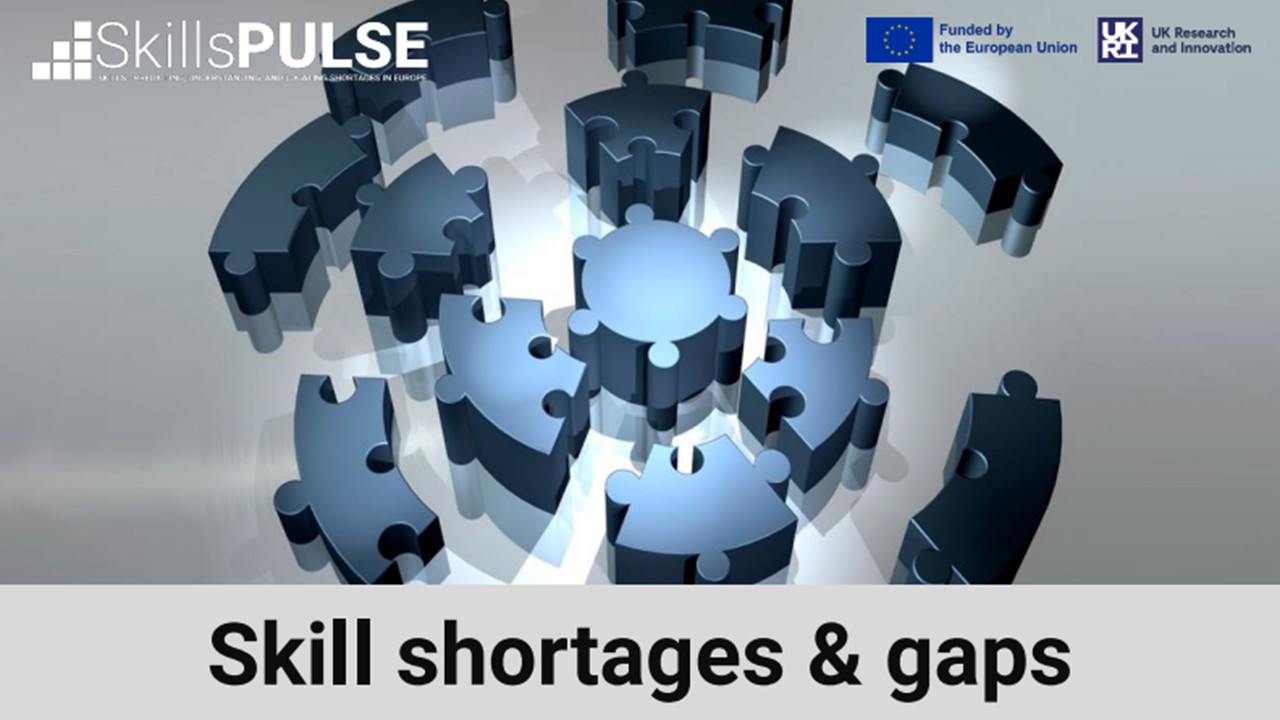





Key insights on skill shortages and gaps in Europe
This infographic presents key findings of three SkillsPULSE reports: “Conceptualising skill shortages and gaps”, “Empirical investigation of skill gaps in Europe”, and “Building new data to understand the impacts of skill shortages and gaps” .
Key insights on skill shortages and gaps in Europe
This infographics shows key insights from three reports “Emerging skills and occupations”, “Integration of emerging occupations and skills into existing frameworks”, “Education system’s response to skill shortages”, and “Qualitative assessment of skill gaps and shortages”, to understand Europe’s skills gaps and shortages.
Insights from international skills intelligence systems
This infographics shows key insights on how different countries identify and respond to skills shortages and skills gaps through institutional arrangements and skills intelligence systems. It is based on earlier work in the project, including a global mapping of skills intelligence systems and detailed case studies of Australia, Canada, New Zealand and Singapore.
D2.1 Conceptualisations of skill shortages and skill gaps
This report examines how skill shortages and gaps are defined and measured, highlighting inconsistencies in existing approaches. It clarifies key concepts and types of labour market mismatches to support more coherent skills analysis and policymaking in Europe.
D2.2 Empirical investigation of skill gaps in Europe
This report analyses skill gaps in Europe, defined as situations where workers lack the skills needed to perform their jobs effectively. It uses survey data to measure undereducation and employee-reported skill needs, highlighting difficulties in consistent measurement.
D2.3 Building new data to understand the impacts of skill shortages and skill gaps on country-level performance
This report highlights limitations in current methods for measuring skill shortages and gaps, which often rely on incomplete or subjective indicators. It introduces a new approach that combines employee survey data with online vacancy data to better assess labour market imbalances across European countries and occupations.
D3.1 Emerging skills and occupations
This report provides analytical framework to analyse skills being in high demand and these which are emerging. Introduces a systematic methodology for detecting skills that are either newly emerging or increasing rapidly in demand, based on online job vacancy (OJV) data provided by Lightcast, covering the period from 2018 to 2024.
D3.3 Integration of emerging occupations and skills into existing frameworks
This report develops the same method as D3.1 using the ESCO (European Skills, Competences, Qualifications and Occupations) classification [Cedefop, ESCO] system to examine the top 20 new and emerging skills across occupations, sectors, and countries (within the EU-27 and UK). And includes strategic skill domains, namely green, digital, and social care-related skills.
D3.4 Education system’s response to skill shortages
This report examines the number and type of courses and programmes that provide opportunities to develop skills identified as new or emerging in the European context. It includes a concise review of relevant literature on the misalignment between education systems and labour market needs.
D3.5 Qualitative assessment of skill gaps and shortages
This report aims to provide a deeper understanding of skills gaps and shortages across Europe. The analysis is based on individual in-depth interviews with a diverse range of stakeholders; the outcomes of workshops in six EU Member States and UK, a research seminar held in Poland, and a critical review of the relevant literature addressing the drivers of skills gaps and shortages.
D4.1 Workplace determinants of skill shortages and gaps: overview of datasets and recent literature
This report provides an overview of the existing datasets that utilise the information about firm characteristics and activities, as well as technological developments more broadly, allowing to link skill gaps and shortages to their firm-side determinants. It also summarises the current state of literature analysing the interaction between them.
D4.2 Report on tackling research gaps
This report identifies key research and data gaps in understanding skill shortages and skill mismatches across Europe. It explores how firm-level factors, organisational practices, and technological change shape workforce skill needs, while proposing innovative approaches to improve monitoring and analysis. The report also introduces a novel patent-based methodology to identify emerging AI-related skills and anticipate future labour market demands.
D4.3 Empirical Analysis Report on the 2026 SkillsPULSE Employer Survey
This report presents the findings of the 2026 SkillsPULSE Employer Survey, conducted among firms in Poland, Greece, Italy, and Finland. It provides new evidence on recruitment challenges, workforce skill gaps, training needs, and the impact of technological change and AI adoption. The analysis offers valuable insights into the drivers of skills shortages and the strategies employers are using to address them across different sectors and firm sizes.
D5.3 Institutional responses to shortages and gaps
This report examine different approaches to identifying and responding to skills shortages and extracting policy lessons from international experience. Australia, Canada, New Zealand, and Singapore were selected based on their demonstrated innovation in skills intelligence, their diverse institutional approaches, and their relevance as potential models for European contexts


