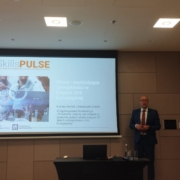

SkillsPULSE unveils new research on emerging skills
SkillsPULSE has released four new reports – “Emerging skills and occupations”, “Integration of emerging occupations and skills into existing frameworks”, “Education system’s response to skill shortages”, and “Qualitative assessment of skill gaps and shortages”– to understand Europe’s skills gaps and shortages.
As labour markets across Europe evolve at unprecedented speed, education and training systems struggle to keep pace.
Emerging skills are often new, rapidly expanding, and not yet included in traditional training programmes. Identifying them early makes it possible to update educational programmes, refocus employment policies, and improve workforce adaptability.
Data driven approach to emerging skills
SkillsPULSE has developed a methodology for identifying skills that are either newly emerging or increasing rapidly in demand across the UE-27 and UK, utilising data extracted from the online job vacancies (OJVs) collected by Lightcast, based on ESCO classification, and covering the period from 2018 to 2024. These are the main conclusions:
- Digital transformation is everywhere
Skills in AI, automation, content creation, CAE software, and ICT knowledge are spreading beyond ICT roles into manufacturing, healthcare, energy, and education. - Soft skills are rising in value
Interpersonal and emotional intelligence competencies, such as keep company and motivate others, are becoming essential in increasingly automated work environments. - Hybrid roles & sector specialisation
Occupations are blending technical, analytical, and social capabilities, with sector-specific needs in compliance, law, and regulation. - Green & care skills in focus
Emerging trends show growth in sustainability-related expertise (e.g., photovoltaic systems) and integrated care skills, often supported by digital tools. - Shifting managerial demands
Future leaders will need a balance of strategic oversight, behavioural adaptability, and data-driven decision-making.
This analytical framework has focused primarily on demand-side drivers of skills shortages and gaps. However, addressing skills gaps and shortages also requires a thorough understanding of the supply side.
Education system’s response to skill shortages
SkillsPULSE has examined how education systems respond to new and emerging skills by reviewing formal, non-formal, and informal learning pathways. These are the key findings:
- Two Complementary Methods:
- A custom web crawler designed to replicate the experience of a typical end-user, showing that finding courses linked to specific skills is often difficult due to platform search limitations and inconsistent terminology.
- The Google Gemini ML tool offered a broader assessment by analysing indexed content, uncovering resources not visible through native search engines.
- Visibility & standardisation issues:
- Many platforms lack transparent skill descriptions and do not align with the ESCO classification, making cross-country analysis difficult.
- Relevant training often exists but is hard for learners to discover.
- Differences across education sectors:
- Higher Education tends to focus on transversal skills.
- Vocational Education and Training (VET) prioritises technical skills.
- Non-formal learning providers are the most responsive to changing labour market demands.
- National frameworks:
- National qualifications frameworks include many emerging skills, but do not always indicate which institutions deliver relevant training, limiting practical guidance for learners.
Qualitative assessment of skill gaps and shortages
Aditionally, SkillsPULSE has explored the nature and causes of skills gaps and shortages at occupational level through the following sources:
- In-depth interviews with employers, trade unions, policymakers, training providers, and experts,
- Workshops in six EU Member States and the UK (late 2024),
- A research seminar in Lodz, Poland (June 2025),
- A targeted literature review on drivers of labour market mismatches.
Key findings:
- Persistent shortages in technical, digital, and STEM skills across sectors.
- Adaptability highlighted as essential for employability in rapidly changing roles.
- Demographic shifts (ageing workforce, care demand) intensify skills pressures.
- Education–labour market mismatch due to rigid curricula, uneven training quality, and poor alignment with employer needs.
- Institutional and regulatory barriers (licensing, wage rules) can worsen shortages.
Explore the full findings and methodology here.
Download the infographics here.