
New research explores how skills complement AI in job vacancies across Italy and Germany
Our SkillsPULSE partner Vito Giordano, from the University of Pisa, has contributed to a new research paper exploring how skills come together in AI-related job vacancies in Italy and Germany.
How are skills combined in AI-related job vacancies, and does this differ depending on workers’ vocational and educational levels?
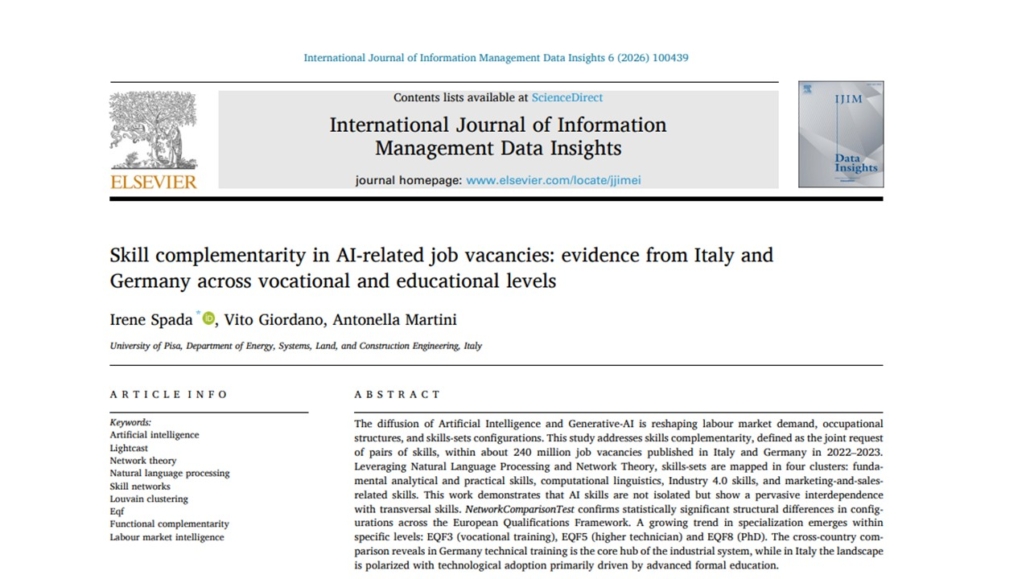
A new paper, “Skill complementarity in AI-related job vacancies: evidence from Italy and Germany across vocational and educational levels”, co-authored by our partner Vito Giordano from the University of Pisa, explores these questions by analysing job vacancies in Italy and Germany.
The study examines around 240 million job vacancies published in Italy and Germany in 2022–2023, using Natural Language Processing and network analysis to investigate how skills are requested together in AI-related vacancies. Rather than looking at AI skills in isolation, the research focuses on their complementarity with other skills and on how these skill configurations vary across different qualification levels.
The analysis identifies four broad clusters of complementary skills:
- fundamental analytical and practical skills;
- computational linguistics;
- Industry 4.0 skills;
- marketing and sales-related skills.
The findings indicate that AI skills are not isolated from other capabilities, but are interconnected with a broader range of transversal and occupational skills. The study also finds that skill complementarity increases with the level of qualification, with patterns of increasing specialisation emerging at EQF levels 3, 5 and 8.
The comparison between the two countries also points to differences in the way skills are configured. In Germany, technical training emerges as a central element within the industrial system, while in Italy the analysis shows a more polarised pattern, with technological adoption primarily associated with advanced formal education.
By looking at skills through the lens of their relationships and co-occurrence, the paper contributes to a better understanding of how AI-related labour market demand is evolving across different educational and vocational levels.
The study was supported by the CIMEA Observatory – the Italian Information Centre on Academic Mobility and Equivalence, which covered the acquisition of the database used in the research.
We are also pleased to highlight that Vito Giordano’s contribution was supported by the SkillsPULSE project.
Read the full paper here.