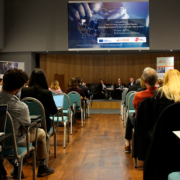
Presentation of the book “Re-thinking Europe’s Skill Needs: Reflections following the European Year of Skills”
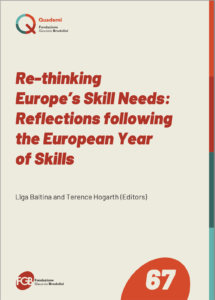
The book “Re-Thinking Europe’s Skill Needs: Reflections Following the European Year of Skills“, published by Fondazione Giacomo Brodolini (FGB) under the SkillsPULSE project, was launched during the SkillsPULSE EU Conference, that took place in Rome, on 29 October 2024, featuring some of the most renowned skills experts in Europe.
The publication is edited by Liga Baltina, Head of FGB’s Labour Market & Skills Research Unit, and coordinator of the SkillsPULSE project, and Terence Hogarth, Professor at the Institute for Employment Research, University of Warwick, partner of the SkillsPULSE consortium.
It contains contributions by: Łukasz Arendt, Liga Baltina, Anaïs Chatagnon, Herman Cherniaiev, Eamonn Davern, Barbara De Micheli, Peter Dickinson, Maria Laura Fornaci, Paolo Gubitta, Terence Hogarth, Ilias Livanos, Seamus McGuinness, John McGrath, José Moratal Miñana, Costanza Pagnini, Robert Pater, Konstantinos Pouliakas, Paul Redmond, Iván Diego Rodríguez, Greta Scarpato, Matteo Sgarzi, and Elisa Staffa.
The recent past has seen Europe subject to a number of crises and challenges: the financial crisis, the climate change crisis, COVID-19, the challenge posed by AI, and the war in Ukraine, with its resultant impact on prices and supply-chain stability.
From a strategic perspective there is a need to be able to anticipate emerging skill needs, perhaps faster than previously, and have in place the mechanisms that can respond in short order to develop the skills required. This is all taking place against a backdrop of increased fluidity in the labour market. People may well be increasingly required to move between jobs and employers in the future, and it may well be the case that in some instances there is no employer, such as in the case of platform workers.
This poses further challenges for skill systems, insofar as employers may be less inclined to invest in the training of their workers if they are unable to appropriate the returns where the employee leaves for another job or has a tenuous link to an employing organisation.
If Europe is about to experience a period of permacrisis against a backdrop of a more fluid labour market, then this is likely to pose a number of challenges to policy makers.
The evidence presented in the volume provides examples of how emerging skill needs and skill imbalances can be better anticipated, alongside information on how to define specific skill needs and effectively deliver them.